Designing the "Nest": The Psychology of Entering the Home Through the "Intrada" Project
Introduction: The Threshold as a Space of Psychological Transition
What does it truly mean to "come home"? In today's fast-paced and often exhausting world, the moment we step through our front door is not merely a physical shift in location; it is a profound psychological transition. Our private space should function as a "nest" of aesthetics, calmness, and decompression—a sanctuary where the noise and stress of the city are permanently left behind.
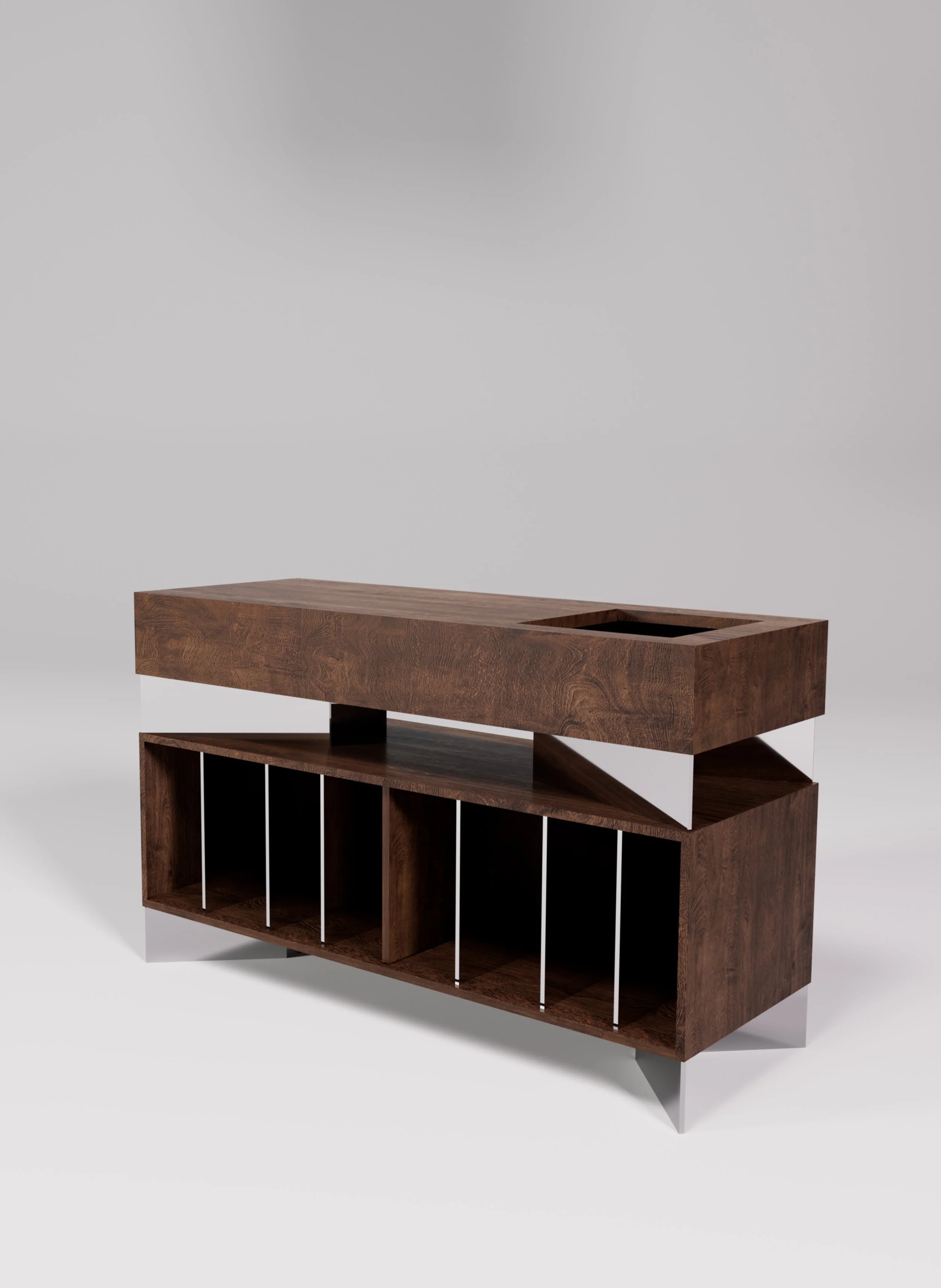
With this core idea as my personal inspiration and design starting point, the "Intrada" project was born. It is an original entryway console, which I designed during the 2nd year of my BA Interior Design studies at Vakalo Art & Design College (Derby University), for the "Furniture Design" module, under the guidance of professor Nikos Ioannou.
Etymology as a Design Tool: Why "Intrada"?
When I began searching for the object's identity, I sought a name that wouldn't act just as a label, but would encapsulate the entire emotional and functional truth of the piece. The choice of the word Intrada has a dual meaning, which aligns perfectly with the final result:
In everyday language: It has Italian roots and literally means entrance. Therefore, it directly responds to the spatial nature of the furniture, as it is intended for a home's foyer.
In musical terminology:Intrada (or Entrata) is a term from Baroque music describing an introductory piece, an instrumental prelude accompanying a procession or the beginning of a formal ceremony.
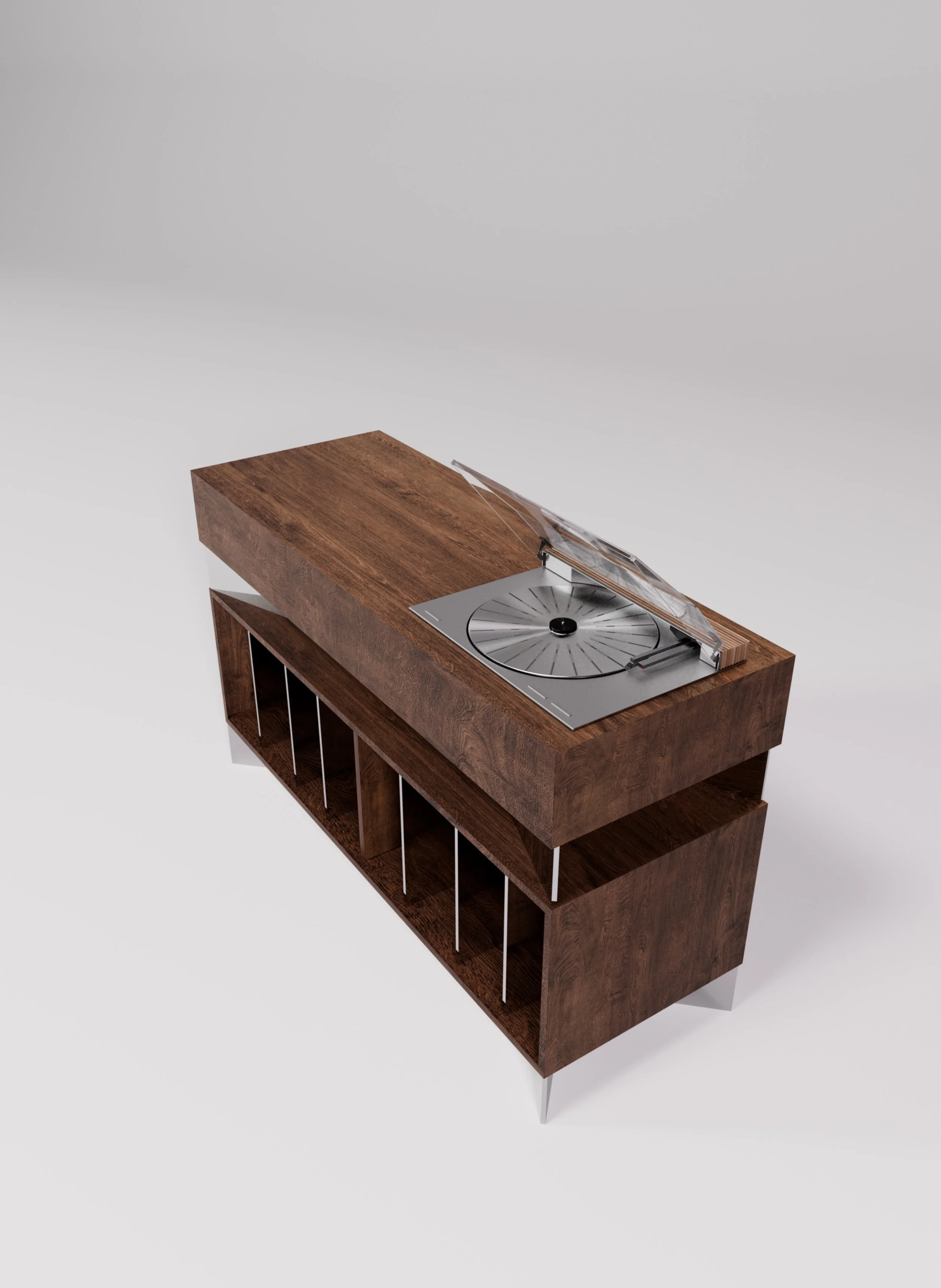
The Connection to the Result: In my design, the Intrada becomes the musical and psychological prelude to our personal decompression. Entering the house turns into a small, daily ritual. As the user walks through the door, the furniture welcomes them and invites them to immediately change their "vibe": to open the wooden body, select a vinyl record, hit play, and let the music dress the space.
This instant dose of beauty is capable of elevating one's mood and transforming their psychology, even if their day up to that minute had been absolutely terrible.
Composing the Form: Wood, Metal, and Functionality
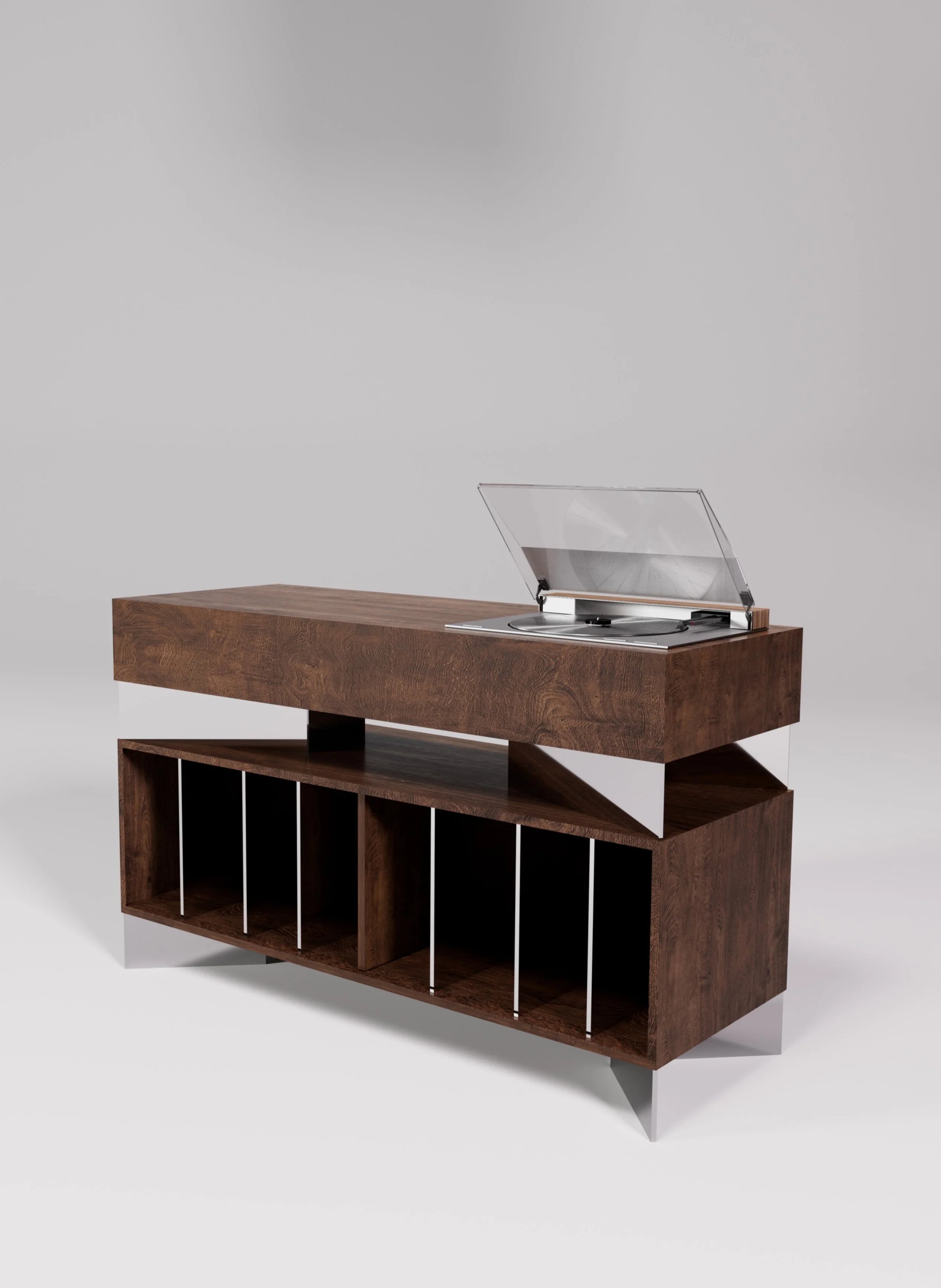
The academic brief gave us complete freedom regarding materials and style, setting form, joinery, and functionality as our main tools for a creative result. To serve the philosophy of a relaxation station, I created a compositional structure of two volumes balancing on a dynamic base:
The Upper Volume (The Listening Station): A solid, clean wooden element with a warm texture that houses the turntable. The protective cover is organically integrated into the design, maintaining the minimalist aesthetic intact.
The Lower Volume (The Vinyl Library): An open, easily accessible space with vertical metal dividers, specifically designed for organizing, protecting, and browsing through a vinyl record collection.
The Base (The Suspension): Custom geometric legs made of folded aluminum sheets. Their development was designed to provide the necessary structural stability required by an audio playback station, while simultaneously giving a sense of levitation and lightness to the console's heavy body.
The Methodology: From Freehand Sketching to Constructional Integrity
A good concept only gains value when supported by technical honesty and precision. The creative journey of this project unfolded over a demanding 6-week sprint, going through all stages of a professional design study:
Freehand Exploration: The initial exploration of the form, the joinery of the individual parts, and the development of the aluminum legs were captured in freehand axonometric sketches. This process allowed for an in-depth understanding of how folds and screws would create a robust structure.
Technical Drawing (1:10 Scale): The drawings were then transferred to a digital environment, shaping the final floor plans, elevations, and side views with absolute and detailed dimensioning in millimeters at a 1:10 scale.
Construction Analysis: A detailed study of the sliding elements and tracks for the smooth operation and retraction of the storage spaces.
Photorealistic Rendering: The project was completed with the creation of 3D renders, emphasizing the faithful representation of materials, the texture of the wood, and the reflectivity of the metal elements.
Conclusion: Design as a Shaper of Human Experience
The experience of designing "Intrada" during my second year at Vakalo taught me that Interior Product Design is not simply about creating "beautiful objects." It is, above all, about shaping the human experience within a space.
"Intrada" started from a personal need for daily decompression and, through a systematic process, evolved into a complete and mature constructional proposal. As a designer, this remains my primary goal: to design objects that communicate with the user's emotions, fundamentally improving their everyday life.